SEO Isn't Enough in 2026 — Time to Learn GEO: Getting AI Search to Cite Your Articles
GEO — generative engine optimization — is how AI assistants choose which sources to cite. Five observed patterns, how to rework old posts, and free tracking.
On this page
Let me start with something I still remember clearly. One morning I was checking my analytics as usual and noticed a little traffic spike the day before, with the source listed as chatgpt.com. I clicked in and found that someone had asked ChatGPT a question, and the AI’s answer directly cited an article I’d written three months earlier, with a link.
Two hundred-plus visitors came in from that one citation. I didn’t promote it, I didn’t pay for anything — the AI itself “decided” my article was worth citing.
My reaction was part delight, part embarrassment. Delight, because passive traffic like this actually exists. Embarrassment, because I hadn’t studied any of the mechanics behind it. So over the following months I wrote and tested in parallel, and mapped out how AI search decides what to cite. This post lays out everything I’ve verified so far.
What is generative engine optimization (GEO)? How is it different from SEO?
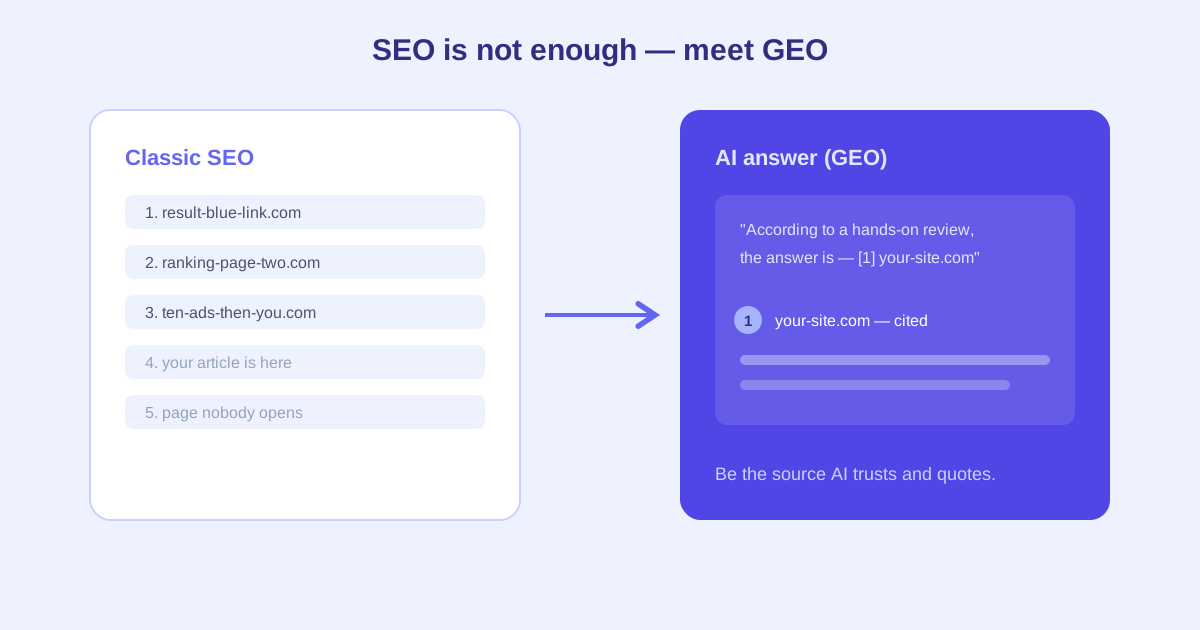
GEO stands for Generative Engine Optimization. The name sounds grand, but it boils down to one line: you used to court the search engine’s crawler; now you court the AI itself.
In the SEO era, you studied keyword density, backlinks, meta tags — serving a ranking algorithm. In the GEO era, tools like ChatGPT and Perplexity read your page and then make a decision: do I cite this in my answer or not? It doesn’t care how well you stuffed keywords. It cares whether your content directly and accurately answers the user’s question.
One thing you shouldn’t get confused: most AI search still builds on traditional search indexes. In other words, SEO is the foundation and GEO is the house you build on top. If you haven’t laid the foundation and jump straight to GEO, you’re building a castle in the air.
5 patterns I’ve observed
Over these months I kept an eye on which of my pages got cited, and on the most-cited articles in my niche. Here’s what I’ve seen:
One, AI likes articles that lead with the answer. The post of mine that got cited opens with the answer right in the first paragraph. AI reads very “lazily” — it wants paragraphs it can lift straight into a response. If you ramble for three hundred words before getting to the point, it may lose patience.
Two, well-structured content gets lifted in clean chunks. Articles with clear subheadings, one idea per section, can be cut out neatly by the AI. Those giant stream-of-consciousness posts are painful for it to parse, and their citation rate is visibly lower.
Three, concrete data and details are gold. “Performance improved nicely” versus “first paint dropped from 3.2 seconds to 1.1 seconds” — the AI will almost always pick the latter. Specific numbers carry built-in credibility, and citing them makes the AI’s own answer look trustworthy.
Four, first-hand experience is hard currency. Here’s my read on it: AI can summarize everything publicly available, but it can’t fabricate “I tested this for three months” details. Your unique experiences don’t exist anywhere else, so if the AI wants a well-rounded answer, citing you is its only option.
Five, content that’s been discussed elsewhere gets cited more. Several of my most-cited posts happen to be ones that were shared and discussed on Reddit and relevant communities. When the AI cross-checks and sees multiple sources pointing at you, it gains confidence in citing you.
How to rework your articles so AI likes them more
Once you know the patterns, the fixing is straightforward. This is the order I follow:
Turn titles into plain-language questions. Don’t write “An Analysis of Static Blog Performance Optimization” — write “How Do I Get a Static Blog to Load in Under 1 Second?” People ask AI the way they’d ask a friend. The more your title resembles the question itself, the easier the match.
Give the answer in the first 100 words. Before you elaborate anywhere, spend two or three sentences stating the core conclusion. Those 100 words are the part AI grabs most often.
Turn subheadings into self-contained Q&A units. Each section should stand alone as a seperate answer, understandable without the surrounding context. Then the AI can lift any section and use it.
Fill it with real stuff. Your measured data, your failures, your before-and-afters — add as much as you can. There’s no shortcut here, and it’s the most valuable part of GEO.
Don’t waste your old posts. I dug out several old articles and reworked them along these lines; the revised ones get cited noticeably more. This is the fastest win in the whole game.
A before-and-after from my own blog
Before: the title was “My Blog Optimization Notes.” The opening was “I spent the weekend tinkering with my blog, here’s what I did,” followed by one long wall of text.
After: the title became “How I Cut My Static Blog’s Load Time from 3 Seconds to 1 Second — Here’s Everything I Did.” The first paragraph states it straight: five optimizations, one weekend, first paint down from 3.2s to 1.1s. The body is split into five sections, each covering one thing on its own, all with data.
That’s all I changed — not one word of filler added. That page is now the most AI-cited page on my site. What made the difference? The old version was uncitable: the AI couldn’t find a single sentence it could lift into an answer.
How to track AI citation traffic for free
No paid tools needed. Three tricks.
Watch referrers in your analytics. In free tools like GA4 or Plausible, chatgpt.com and perplexity.ai show up as referrers. In GA4, build an exploration report with the source regex like this to filter all AI channels at once:
chatgpt\.com|perplexity\.ai|gemini\.google\.com|copilot\.microsoft\.com|claude\.ai|you\.comWatch the crawlers that come to you. In your server access logs, AI crawlers announce themselves by name. One command shows you which pages they’ve been crawling:
grep -iE "GPTBot|PerplexityBot|ClaudeBot|Google-Extended" access.log | awk '{print $7}' | sort | uniq -c | sort -rnIf a page gets crawled heavily but never cited, it’s almost certainly a content-format problem — go back and restructure it as described above.
Ask the AI yourself. Every so often, take the questions your articles cover and ask ChatGPT and Perplexity directly. Does it answer? Does it cite you? It’s the dumbest and most honest verification method there is. I do a round every month.
Watch branded searches that follow. After someone clicks through from an AI answer, they may later search for your site name directly. Whether those searches are growing in your analytics is another side signal.
A few misconceptions, while we’re here
“AI-written articles never get cited” — not accurate. AI picks content by quality and structure, not by whether a human wrote it. That said, mass-produced AI content with no first-hand detail is definately hard to get cited, because the web is drowning in it and the AI has no reason to pick it.
“Short content has no chance” — quite the opposite. AI citations often need just one paragraph. One paragraph that fully answers a question beats 3,000 words trying to cover everything.
“GEO means throwing SEO away and starting over” — no. The index is still the same index. Solid SEO content converts to GEO-friendly content with a light touch. People who frame them as opposites are usually trying to sell you a course.
Where I’ve landed
After months of tinkering, my conclusion is this: GEO isn’t some new mysticism. It’s the old, boring virtue of writing content that’s solid — clear conclusions, clean structure, real details — arranged the way machines prefer to read.
Traffic moving into AI conversations has already happened. The people who notice early are just positioning the same content one step ahead. Your SEO work isn’t wasted — the foundation is still there. Build the house on top of it.
Go open one of your old posts and rework it. That’ll teach you more than ten GEO think-pieces.
Frequently asked questions
What is GEO in simple terms?
Generative engine optimization: structuring your content so AI assistants like ChatGPT or Perplexity cite it as a source, not just search engines ranking it.
Is GEO replacing SEO?
No. Search traffic still dominates, and AI answers largely draw on pages that already rank. GEO extends SEO; it does not replace it.
How do I know if AI tools are citing my site?
Check referral traffic from AI assistants in your analytics, and ask the major chatbots questions in your niche to see whether your pages appear.