I Paid for Both Claude and ChatGPT for Six Months. Here's the Honest Truth About Which One Is Worth It
Six months paying for both Claude and ChatGPT: writing quality, coding, long documents, tool ecosystems and value for money — plus who should pick which.
On this page
People keep asking me the same question in my comments: Claude or ChatGPT — which one should I subscribe to?
I used to reply in a sentence or two and move on, but I’ve realized this question can’t actually be answered that quickly. I use both, I pay for both, and I’ve been doing it for six full months. Each has its own lane, and canceling either one would hurt. So I’m laying out six months of real experience in one post, for everyone who’s still on the fence.
This is not a drive-by review based on press releases. I use them every single day, and every example below is something I actually ran.
The Hard Specs First
If you’re in a hurry, here’s the overview. Both official sites are linked: Claude and ChatGPT — treat their official pages as the source of truth for specs.
| Claude | ChatGPT | |
|---|---|---|
| Paid tier | $20/mo | $20/mo |
| Context window | 200K | 128K (smaller on some models) |
| Long-document analysis | Strong, rarely chokes | Decent, gets vague when long |
| Coding depth | Strong | Above average |
| Image generation | None | Yes |
| Voice conversations | Mediocre | Strong |
| Memory / personalization | Projects system | Global memory |
| Free tier usability | Average | Pretty good |
Specs are dead numbers. Don’t jump to conclusions yet — here’s the living experience.
Writing Quality: Claude Genuinely Wins, and It’s Not Even Close
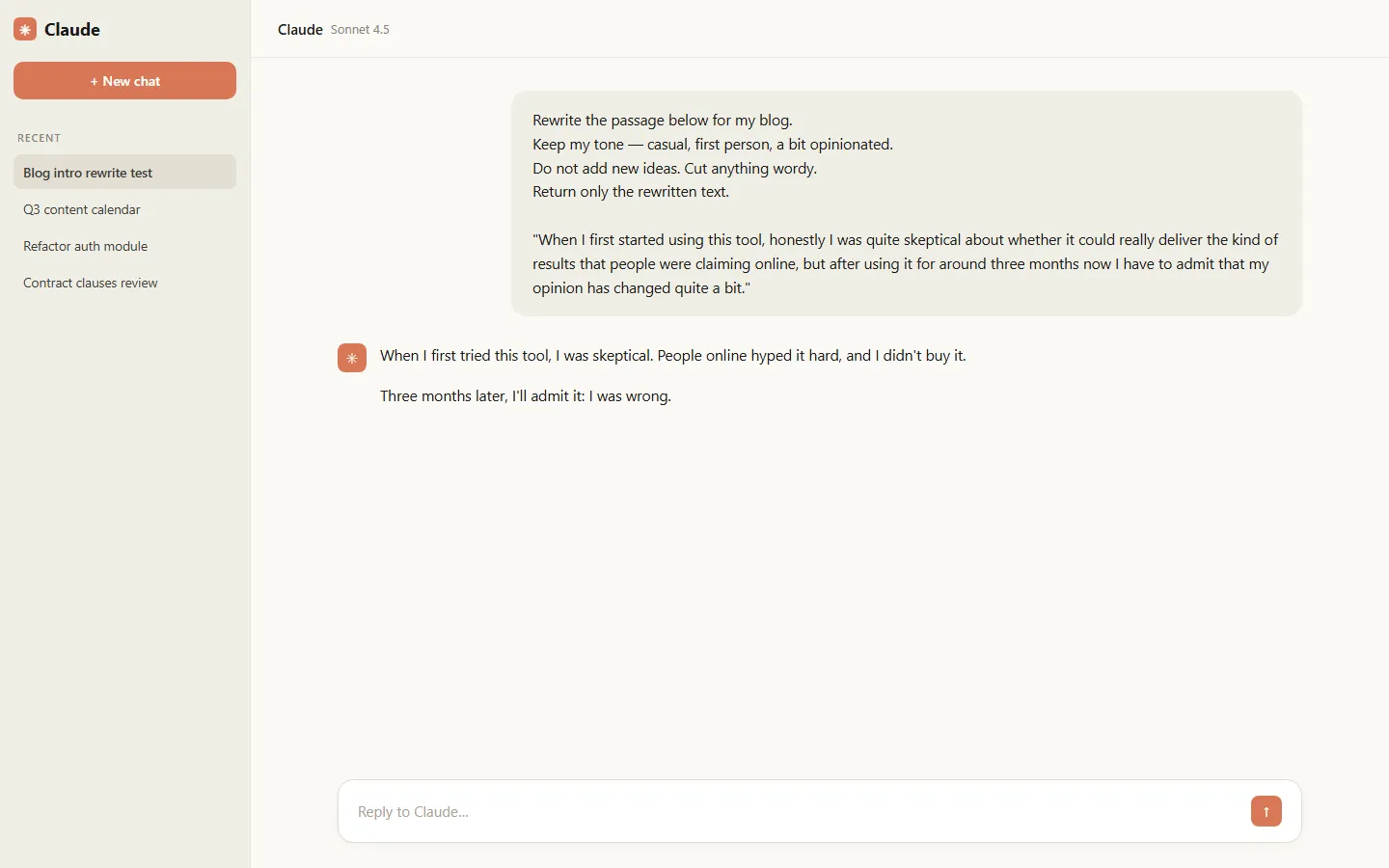
I ran a test: the same draft to both, identical prompt:
Rewrite the passage below for my blog.
Keep my tone - casual, first person, a bit opinionated.
Do not add new ideas. Cut anything wordy.
Return only the rewritten text.
Claude’s version made my first reaction “wait, did I write this?” — it preserved my voice, touched only what needed touching, and outright deleted one of my wordy transitions. The deletion was right.
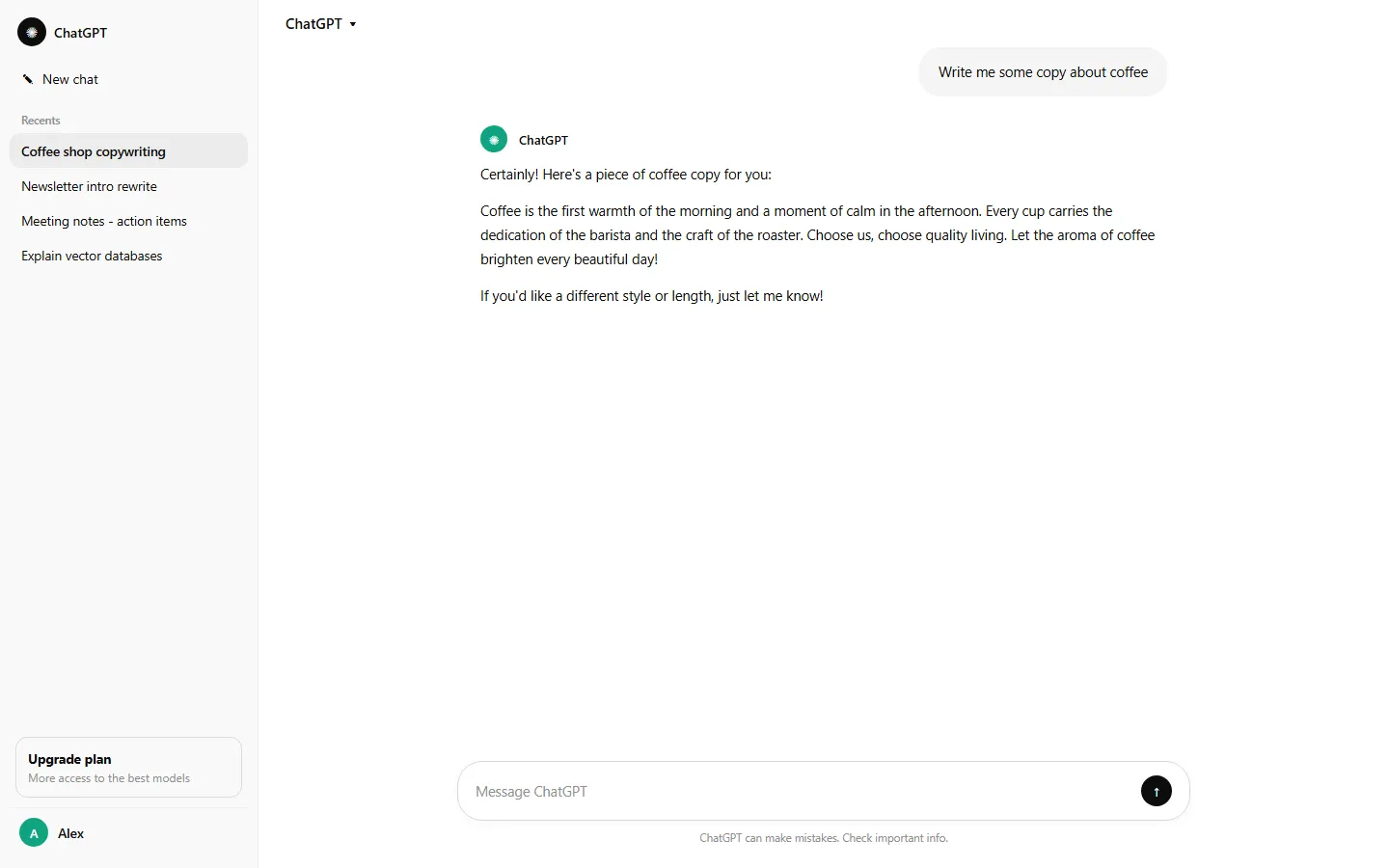
Here’s ChatGPT on the same prompt:

Neat, correct, unimpeachable — like a student essay polished to a teacher’s perfect score. Usable, but “my voice” faded a notch.
My internal ranking for writing: long-form rewriting, style mimicry, casual-tone conversion — Claude wins by a landslide. Short informational copy — roughly a tie. Chinese writing leans Claude, English writing is even.
Coding: Big Jobs Go to Claude, Small Jobs Are a Coin Flip
I tested both with a piece of my own old garbage code:
def get_active_users(users):
    result = []
    for u in users:
        if u["active"] == True and u["last_login"] != None:
            result.append(u)
    return result
Simple ask: refactor it, add type hints. Both got it right, but Claude went further — it pointed out that == True is redundant, suggested compressing it into a list comprehension, and flagged the empty-list edge case. ChatGPT’s version was also correct; it just does exactly what you ask and nothing more. You don’t ask, it doesn’t tell.
The real divide shows up on big jobs. I had a 3,000-line legacy project to refactor. Claude, paired with its command-line tool, ingested the whole project structure before touching anything, and the result passed on the first run. With ChatGPT I had to feed it file by file, and by the end it started forgetting the conventions we’d agreed on earlier. That’s not an intelligence gap — it’s a context-capacity and engineering gap.
One-line fixes, explaining an error, writing a regex — both are fine. Pick whichever is open in a tab.
Long Documents: No Contest Here
The meanest test I’ve run: a 90-page English contract PDF, dumped into both, with questions about clause details hiding past page 60.
Claude went full marks. It didn’t just find the clauses — it laid out two contradictory statements side by side for comparison. Traps buried deep in a document are exactly where that 200K context window earns its keep.
ChatGPT’s answers were solid for the first half, but on the deep questions it went “in summary” mode, and one number it cited didn’t match the source text. I re-tested with two more long docs and the pattern held: under 50 pages, either works. Beyond that, don’t think twice — Claude.
If you translate, review contracts, or read papers for a living, this one row is worth the subscription decision on its own.
Tool Ecosystem: ChatGPT Goes Full Firepower, Claude Is Honestly Thin
This is ChatGPT’s home turf, and I’ll concede it outright.
It generates images — I have it make blog illustrations all the time. Voice mode is my English practice partner on commutes, smooth enough to feel like a real person. Global memory means it knows who I am and what I’m working on; new conversations don’t start with a self-introduction. The GPTs store has a ready-made mini-tool for everything.
Claude’s bright spot here is Artifacts — it can build a working little tool and preview it mid-conversation. I made a reading-time calculator without ever leaving the chat window. But: no image generation, mediocre voice, and its memory story routes through Projects, which is a slightly higher hurdle for total beginners.
One line to sum it up: Claude’s abilities are built for work, ChatGPT’s are built for life.
Value for Money: Both Worth It, Just Worth It Differently
Both are $20/month, so price isn’t the question. The question is what your $20 buys.
If it buys writing quality, coding depth, long-document muscle — Claude’s $20 is spent on differences you can literally see across the paywall.
If it buys an all-rounder, peace of mind, one app that handles everything — ChatGPT’s $20 is a Swiss Army knife: no single blade is the best, but no missing blades either.
My test is simple: do you pay for AI to produce things, or to lend a hand around the day? Former is Claude, latter is ChatGPT.
Who Should Pick Claude, Who Should Pick ChatGPT
No hedging. Straight lists.
Pick Claude if you:
- Write posts, newsletters, or content where text quality actually matters
- Code, especially refactoring, reading large codebases, or using the CLI tool
- Handle long documents regularly: papers, contracts, reports
- Are sick of AI text that reads like a translated manual
Pick ChatGPT if you:
- Want one app that does it all: images, voice, search, memory
- Don’t use AI heavily every day; your needs beyond the free tier are scattered
- Rely on voice: commuting, language practice, hands-free input
- Share an account with family (its multimodal friendliness for non-technical users is unmatched)
3 Alternatives Worth Considering
Beyond the big two, here’s my honest impression of the ones I’ve used for a while.
Google Gemini: context window up to 1M — you can throw whole books at it — and multimodal is strong. The downside: its writing has an odd flavor, especially in Chinese, like someone who is very correct and has no soul. Great if you live inside the Google ecosystem.
Perplexity Pro: strictly speaking it’s not a chat AI, it’s a search engine with citations. For research and chasing news it’s the most reliable — every claim comes with a source link. But it’s not a workhorse; don’t expect long-form writing from it.
GitHub Copilot: $10 a month, the cheapest of the bunch. But it only cares about what’s inside your editor; outside VS Code it’s nothing. As a second subscription for coders it’s lovely; as your main one, not enough.
My Actual Setup
Six months of failing to cancel either one, and this is where I landed:
- Writing, editing, long documents, serious coding → Claude
- Image generation, voice chats, time-sensitive lookups, random quick questions → ChatGPT
- Real-time completions inside the editor → GitHub Copilot (that one’s only $10)
That’s $50 a month total. Not cheap, not crazy. I did the math: the writing side saves me more time than that’s worth, and the ChatGPT side buys the comfort of “I can ask about anything.”
If your budget only fits one, keep reading.
Quick FAQ
Can I get away with just one? Yes. Eight out of ten people need only one. List what you asked AI to do last week: if over half was “write this / edit this / read this,” go Claude. If over half was random errands plus images and voice, go ChatGPT.
Does it matter for non-English content? It does. Claude is noticeably more natural for long-form non-English writing; ChatGPT’s can carry a translated flavor, though recent versions have closed the gap. For everyday Q&A, both are fine.
Which free tier should I try first? Both. ChatGPT’s free tier is more generous, so you can get going right away; Claude’s is tight but enough to taste how it writes. Spend one week throwing real tasks at both — you’ll feel the difference yourself, and that beats reading ten comparison posts.
The Bottom Line
One-sentence conclusion: subscribe to Claude to produce work, subscribe to ChatGPT for an all-around companion — and if the budget allows, get both. That’s not fence-sitting; that’s a division of labor I paid two subscriptions’ worth of tuition to learn.
Frequently asked questions
Is Claude better than ChatGPT for writing?
For prose quality, yes — Claude needs fewer rewrites and sounds less generic. ChatGPT wins when you need tools, images or a wider ecosystem.
Can I use the free versions instead of paying?
You can try both free, but rate limits get painful fast. This comparison is based on six months on both paid plans.
Which one should I pay for in 2026?
Writers and long-document workers: Claude. Tool-heavy workflows, image generation and plugins: ChatGPT. Many people genuinely need both.