Prompting Isn't Magic — I Worked Out a Method Anyone Can Learn
How to write prompts that actually work: a learnable method — the 6 core elements, 5 techniques, 3 traps and 10 templates to steal.
On this page
I once bookmarked twenty-something prompt engineering tutorials. Reading them left me with two flavors of useless: either “be polite to the AI, say please and thank you,” or walls of jargon — chain-of-thought, few-shot, role-play matrices. The more I read, the more lost I felt.
I copied those fancy templates and got inconsistent results, pure luck whether they worked. Eventually I got annoyed, laid my best-performing prompts side by side, and realized there’s no magic at all. Well-written prompts keep circling back to the same handful of elements. Once that clicked, both my speed and my hit rate jumped — the odds of getting what I want on the first try went from thirty percent to eighty or ninety.
The 6 core elements of a prompt
1. Role: tell it who it is.
Faced with “write some copy,” the AI has no idea whose voice to use. Give it an identity and the output immediately comes into focus.
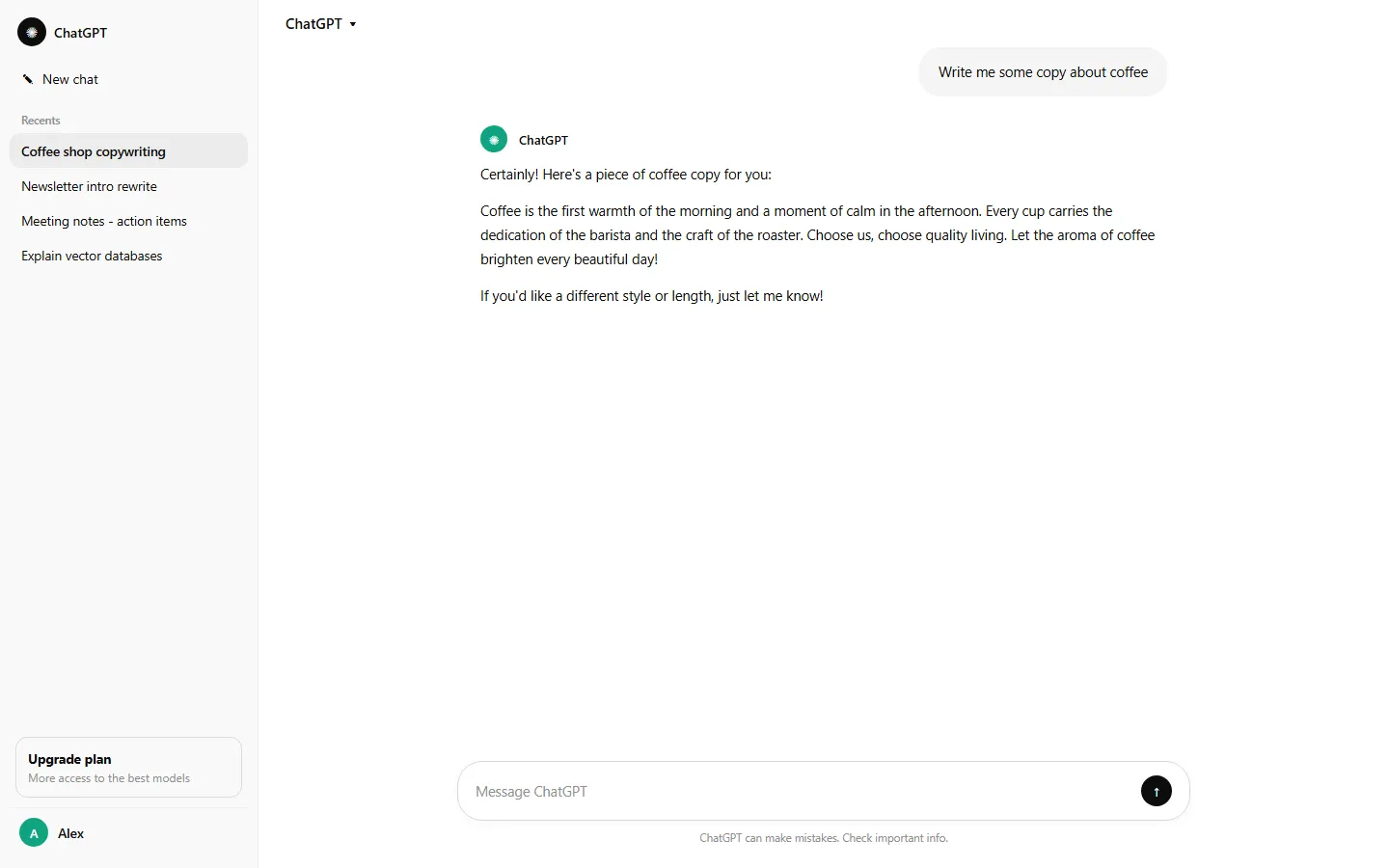
Bad: Write me some copy for a coffee shop. Good: You’re the owner of a specialty coffee shop. You talk straight and hate pretentious café-speak. Write an Instagram post for me.
2. Context: say who it’s for and where it’ll appear.
The same text reads differently on Instagram versus a printed menu. If you don’t say, it can only guess.
Bad: Write something about effortless learning. Good: Write for commuters with a one-hour ride each way who want to learn things but are wiped out after work. Publishing on Instagram.
3. Task: say what to do, with a concrete verb.
“Help me handle this” and “optimize this” are disasters. The task needs a specific verb: rewrite, list, compare, translate, summarize into three bullets.
4. Format: define what the output looks like.
Want a table, say table. Want five items, say five. Want each item in one sentence, say so. No format specified, you get a wall of text by default.
5. Examples: hand it the homework to copy.
One example beats ten adjectives. “In a style like this: …” is a hundred times more precise than “make it funny.”
6. Constraints: mark what’s off-limits.
If you don’t say what you don’t want, the AI serves you everything. Word caps, banned tones, words that must not appear — state them upfront.
You don’t need all six every time. But whenever output disappoints, come back to this checklist — nine times out of ten you missed one.
5 techniques worth learning
Make it ask questions first. Why: the AI guesses your needs, and a wrong guess wastes everything. How: end your prompt with “Before you start, ask me 5 questions you need answered.” Answer them, and you’re aligned in one round. Essential for plans and strategy work.

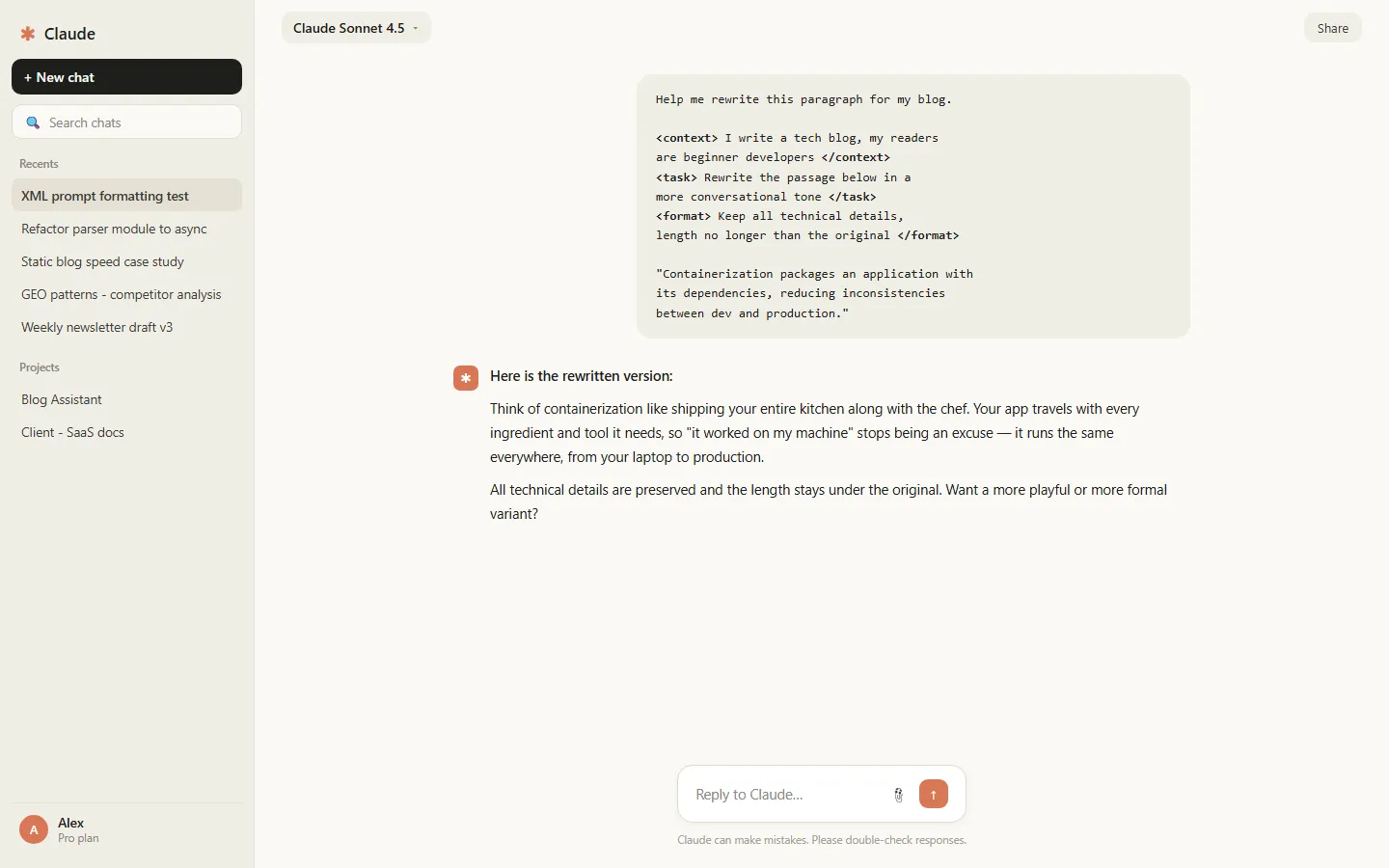
Give examples. Why: human apprentices learn by imitation; so does the AI. How: paste one or two samples you like and say “match this style.” I keep a style document for my blog, so every new post starts by showing it an old one to lock in the voice.
Ask for the skeleton first. Why: long content goes off the rails when done in one shot. How: request an outline or bullet list first, confirm the direction, then have it expand. Rework cost drops from “rewrite everything” to “fix three lines.”
Iterate instead of one-shotting. Why: the conversation continues; the first draft is just a starting point. How: point at what’s off — “item two is too long, cut it to one sentence” / “give me a version without exclamation marks.” People who chat well beat people who write incantations.
Make it review itself. Why: it finds its own flaws faster than you can. How: after the output, follow with “Check this and list the 3 points a reader would most likely challenge.” It really will find them.
3 traps I fell into
Too vague. “Make it better” is useless — better has no definition. Clarity does.
Asking for too much at once. “Write ten articles, five titles each, plus summaries and keywords” — everything comes out mediocre. Split it up. One task at a time.
Wanting imitation without giving examples. You say “like that big influencer’s style” — the influencer in its head isn’t the one in yours. Paste the sample.
10 templates you can use today
Writing
Rewrite the content below in [platform] style, tone [requirement], keep all information, end with an engagement question: [paste]
You’re an editor in [niche]. Cut this draft by 30%. Only delete, don’t change meaning. Mark deletions with [cut]: [paste]
Based on these points, write a [length] short article whose first paragraph states the conclusion: [points]
Work
You’re a veteran [role] at my company. Here’s the context on [matter]: [context]. Before starting, ask me 5 questions you need answered, then give me your plan.
Turn these [duration] meeting notes into action items, format: owner / task / deadline. Anything without an owner goes in a separate list: [paste]
Explain [matter] to a non-technical executive in under 150 words. Must include one analogy.
Learning
Explain [concept] using analogies a high-schooler would get, then give me 3 self-test questions from easy to hard.
Here are my notes: [paste]. Find the 3 places my understanding is most likely wrong and explain why.
Coding
This code throws an error: [error]. Code: [paste]. List 3 likely causes ranked by probability, then a way to verify each.
Review the code below. Only flag things that would cause bugs or performance problems. No style comments: [paste]
How to practice: the 10-minute rewrite game
Stop collecting tutorials. Here’s the drill: every day, take one of your own prompts that flopped, rebuild it against the 6-element checklist, then run both versions and compare the outputs.
I did this for two weeks. The biggest change wasn’t learning incantations — it was acquiring a reflex: before hitting send, ask yourself — did I give the role? Enough context? Said the format? Those three questions kill most wasted conversations.
Wrapping up
A prompt isn’t better because it’s more complicated. It’s better because it’s clearer. Those impressive long incantations, taken apart, are just role, context, task, format, examples, and constraints — all stated.
You don’t need to become a prompt engineer. You need the habit of saying things clearly — and that skill pays outside of AI too.
Take the prompt that flopped on you most recently and rebuild it against the 6 elements today. You’ll see the gap yourself.

Frequently asked questions
What are the core elements of a good prompt?
Six of them: role, task, context, format, constraints, and examples. You rarely need all six, but knowing which one is missing is the skill.
Does prompt engineering still matter in 2026?
Yes. Models got better at guessing intent, but vague input still produces generic output. Structure is the cheapest way to upgrade your results.
How long should a prompt be?
Long enough to remove ambiguity, short enough that you will actually reuse it. Two to six sentences with one clear example beats a page of rules.